


Reflector vs Projector LED Headlights: Key Differences in Beam Control, Fitment and Retrofit

Follow us now:
How Reflector and Projector Headlights Control Light
A reflector headlight uses a reflective bowl to direct light from the source toward the road.
The shape of the reflector controls how the light is distributed.
A projector headlight also uses a reflector or optical bowl, but adds a cutoff shield and a projector lens.
A typical projector system can include:
The lens does not create the beam pattern by itself.
The final pattern comes from the relationship between the source position, reflector geometry, cutoff shield, lens, and mounting angle.
A reflector system relies more directly on the reflector surface to shape the beam. A projector system uses several optical components to control the light before it leaves the headlamp.
Beam Pattern and Cutoff Differences
The beam pattern is one of the clearest differences between reflector and projector systems.
Reflector headlights can produce different beam shapes depending on the reflector design, bulb position, and headlamp geometry.
Projector systems commonly use a cutoff shield to create a defined upper boundary in low beam.
A reflector system should also be evaluated by its complete road-light distribution rather than by the appearance of one bright area.
The projector lens beam pattern provides a practical reference for evaluating cutoff, width, hotspot, foreground illumination, and high-beam alignment in projector applications.
Brightness and Light Distribution Are Not the Same Thing
A brighter-looking beam is not automatically a better beam.
Brightness describes how much light is present at a point or area. Light distribution describes where that light is placed.
Can make one area look very bright while leaving side illumination or foreground balance less useful.
Can illuminate more lateral area while producing a different central intensity profile.
A single lumen, lux, or wattage figure does not describe the complete optical result.
A more useful comparison looks at central intensity, beam width, foreground illumination, vertical light distribution, cutoff control where applicable, and high-beam reach.
Glare Control Depends on Optics and Alignment
Glare is often discussed as if one headlight type automatically creates more or less of it.
The real result depends on the optical design, light-source position, aiming, and installation.
A projector can produce a controlled cutoff when the source, shield, lens, and mounting position are correctly aligned. The same projector can produce an incorrect beam if it is rotated or aimed incorrectly.
A reflector headlight can also create excessive stray light when the light source is not positioned correctly relative to the reflector.
The Bi-LED projector retrofit process should include beam checks before the projector or headlamp is permanently fixed.
Housing Space and Fitment Differences
Reflector and projector systems also differ in the amount and type of space they require.
A reflector headlamp normally integrates the reflective bowl into the housing. A projector adds a separate optical assembly that must fit inside the headlamp.
Nominal lens size alone does not determine whether a projector will fit.
The differences between 2.5-inch and 3-inch Bi-LED projector lens sizes can affect housing space, mounting position, thermal clearance, and adjustment range.
Retrofit Complexity and Installation
Replacing a light source inside an existing reflector headlamp and installing a projector are different retrofit tasks.
A reflector-based upgrade may keep more of the original headlamp structure.
A projector retrofit can require additional work such as:
The exact process depends on the headlamp and mounting method.
For compact retrofit applications, H4 Mini Bi-LED projector fitment and compatibility should be checked through housing depth, rear clearance, socket-area mounting, cooling space, wiring, and final beam alignment.
When Bi-LED Projectors Make Sense
Bi-LED projectors can be useful when the application needs a controlled projector beam and both low and high beam in the same optical assembly.
They may also be considered when a retrofit project needs a more defined optical structure than the original reflector arrangement provides.
That does not mean a Bi-LED projector is automatically the correct solution for every headlamp.
Projector mounting, housing depth, lens clearance, thermal space, electrical connections, and final aiming.
Optical structure, cutoff control, LED source position, high/low switching, thermal design, driver configuration, mounting dimensions, and production consistency.
The Bi-LED projector lens features should be evaluated as part of the whole system.
The Bi-LED projector lens selection process can then be used to match those features to the actual headlamp and vehicle requirements.
What B2B Buyers Should Compare Before Sourcing
For distributors, workshops, and automotive lighting brands, reflector-versus-projector comparison is only the first decision.
The next step is to evaluate the product as a sourcing item.
At EKLIGHT, application information such as headlamp photos, housing dimensions, mounting method, and target beam requirements can be used to discuss suitable Bi-LED projector lens configurations.
If you are comparing reflector and projector solutions for a retrofit workshop, distribution program, automotive lighting brand, or private-label project, provide the available vehicle information, headlamp photos, housing dimensions, installation method, and target beam requirements.
EKLIGHT can use the supplied application information to discuss projector formats, fitment considerations, and Bi-LED projector options.
FAQ
What is the main difference between reflector and projector headlights?
Reflector headlights use the reflector bowl to shape and direct light, while projector headlights combine a reflector or optical bowl with a cutoff shield and projector lens to control the beam.
Do projector headlights always provide better beam control?
Not automatically. Beam control depends on the optical design, light-source position, cutoff shield, projector alignment, and final headlamp aiming.
Can a projector retrofit reduce glare?
A correctly matched and aligned projector can help control the low-beam cutoff, but glare still depends on source position, mounting angle, aiming, and installation quality.
What should be checked before installing a Bi-LED projector?
Check projector depth, lens clearance, mounting position, rear cooling space, wiring, driver location, adjustment range, and final beam alignment.
How do 2.5-inch and 3-inch projectors differ in retrofit applications?
The size difference can affect housing space, mounting geometry, cooling clearance, and adjustment range. The complete projector dimensions should be checked rather than lens diameter alone.
What should B2B buyers compare when sourcing projector headlights?
Compare beam pattern, cutoff control, housing fitment, mounting structure, thermal design, electrical configuration, sample consistency, and application records.
- How Reflector and Projector Headlights Control Light
- Beam Pattern and Cutoff Differences
- Brightness and Light Distribution Are Not the Same Thing
- Glare Control Depends on Optics and Alignment
- Housing Space and Fitment Differences
- Retrofit Complexity and Installation
- When Bi-LED Projectors Make Sense
- What B2B Buyers Should Compare Before Sourcing
- FAQ
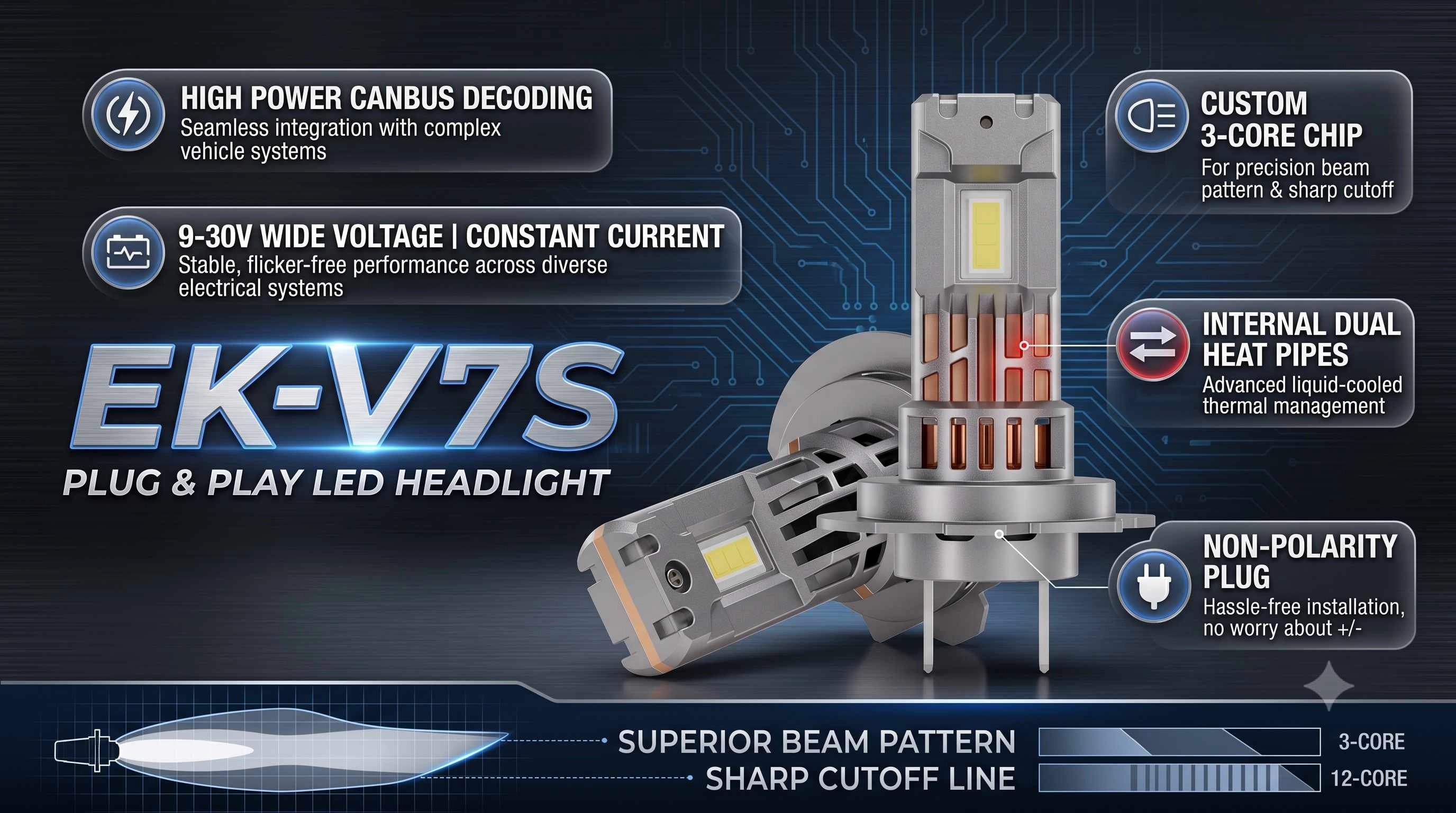
Why Choose the EK-V7S Plug-and-Play LED Headlight Bulb Over High-Core Alternatives?

What Features Make a Bi-LED Projector Lens Stand Out in Automotive Lighting?
Contacts
EKLIGHT
WhatsApp/Phone

M6 50W/60W IP68 LED Headlight Projector Lens 9–16V | OEM/ODM Supply
M6 50W/60W IP68 LED Headlight Projector Lens 9–16V | OEM/ODM Supply
Best Auto Led Headlights | Custom Car Led Headlights
Best Auto Led Headlights | Custom Car Led Headlights
Mini H4 Bi-LED Projector Lens with Custom Optical Design | OEM Supply
Mini H4 Bi-LED Projector Lens with Custom Optical Design | OEM Supply
IP68 Tri-Color High-Lumen Bi-LED Fog Light Lens | Wholesale
IP68 Tri-Color High-Lumen Bi-LED Fog Light Lens | WholesaleDon’t Miss Our Latest Insights
Enjoying this article?
Subscribe to receive more industry insights, product updates, and automotive lighting innovations from EKLIGHT.
Stay informed and ahead of the market.
EKLIGHT delivers innovative, high-quality LED lighting solutions trusted by global partners.
We empower businesses with reliable products that enhance performance and drive success.
Contact EKLIGHT
Address : Building C, Dehuiwanggang Industrial Zone, No. 38 Wanggang Industrial three road, Baiyun district, Guanghzou, Guangdong province, China.
© 2026 EKLIGHT. All Rights Reserved.
EKLIGHT
EK
EK
EK
EK