


Fog Light Lens Quality Inspection Checklist for B2B Buyers
Follow us now:
Key Takeaways
Move from product identification toward an approved reference and repeatable production comparison.
Quality Inspection Starts With Product Identification
A detailed inspection has limited value if the unit being tested is not the configuration specified by the buyer.
Fog light lens products can vary in beam function, optical structure, color configuration, connector arrangement, mounting interface, driver layout, and other application-related details. Broader fog light lens sourcing criteria can help establish which characteristics need to be confirmed before inspection begins.
A confirmed specification, dimensional drawing, approved sample, photographs, or another agreed reference can support product identification. The objective is to ensure that everyone involved in the evaluation is inspecting the same sourcing configuration.
Use Visual Inspection as an Early Screening Step
Visual inspection can identify assembly differences before the product enters optical or electrical testing.
Visible contamination, damage, incomplete assembly, or differences from the approved configuration can be recorded before functional testing continues. Cosmetic observations should remain separate from conditions that affect fitment, optical output, electrical operation, or assembly.
Inspect the Installation Envelope, Not Diameter Alone
Projector depth, mounting-hole position, bracket geometry, rear clearance, connector orientation, heatsink structure, driver location, wiring space, and adjustment clearance can all affect installation.
For projects with restricted space, projector module dimensions and installation clearance become especially relevant.
| Fitment Point | What to Check | Purchasing Relevance |
|---|---|---|
| Overall envelope | Required width, height, and depth | Confirms available installation space |
| Mounting interface | Hole positions or bracket geometry | Supports assembly compatibility |
| Rear clearance | Heatsink, driver, and connector area | Identifies possible interference |
| Wiring position | Cable and connector orientation | Supports routing during installation |
| Adjustment space | Required aiming clearance | Supports optical setup after installation |
Acceptance values should come from the actual product requirement or confirmed technical information for the sourcing project rather than a generic dimensional tolerance applied to every fog light lens.
Keep Beam Pattern Testing Repeatable
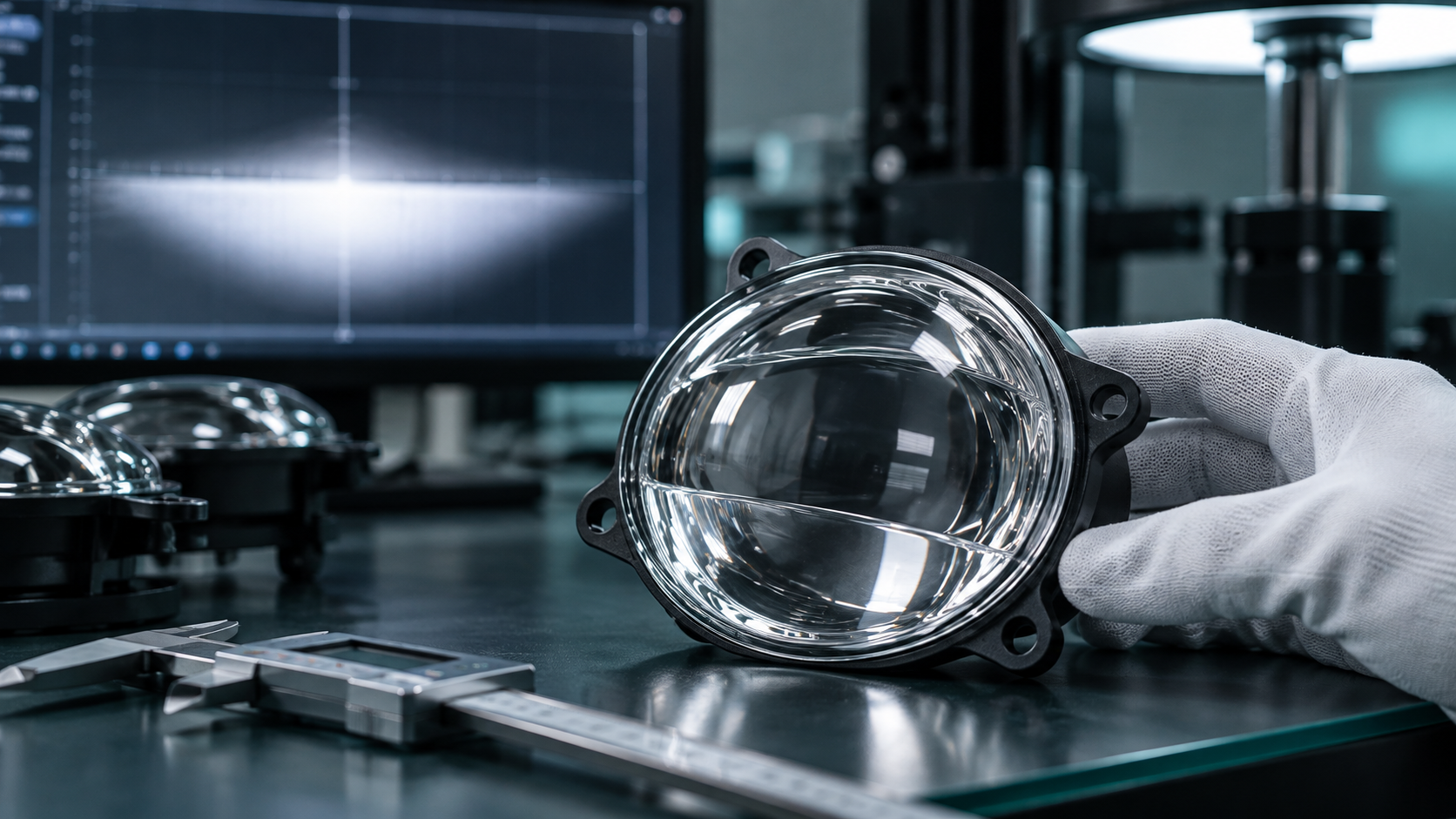
Mounting position, aiming, power supply, operating duration, test distance, and surrounding conditions can influence what appears on the test surface. When these factors change substantially, product variation and setup variation become difficult to separate.
Once an acceptable sample has been evaluated under defined conditions, its beam pattern and cutoff evaluation can become part of the approval reference for later comparison.
Separate Beam Function From Beam Quality
The number of operating functions does not establish the quality of the projected beam.
Where different projector architectures are being compared, Bi-LED and LED fog light configurations should still be evaluated according to the required operating mode and optical result.
Where switching is part of the product configuration, the relevant electrical interface and switching behavior can also be included in sample evaluation.
Verify Color Configuration Separately
Color temperature is a separate specification dimension from beam architecture. If a sourcing project requires 3000K, 6000K, dual-color operation, or another confirmed configuration, the required operating combinations should be recorded explicitly.
EKLIGHT currently lists a specific 2.0-inch Bi-LED projector fog-light configuration with 35W/45W and 3000K/6000K specifications. Those parameters belong to that product rather than every fog light lens configuration.
Keeping fog light color temperature options separate from beam architecture helps purchasing teams compare quotations and samples against the intended configuration.
Check Electrical Requirements Against the Approved Configuration
A power-on test confirms basic operation, but multi-function products may require additional checks for connector arrangement, wiring configuration, operating modes, and switching behavior.
Connect Thermal and Environmental Checks to the Product
Initial illumination does not describe the complete operating condition of an LED lighting product. Installation space, heat path, heatsink arrangement, driver position, sealing interfaces, and operating duration can influence later evaluation.
Buyers defining thermal and waterproofing requirements for fog light lenses should connect each environmental requirement to the identified product configuration and appropriate supporting evidence.
Information belonging to one product should not automatically be applied to another configuration.
Turn Sample Approval Into an Identifiable Reference
Sample approval becomes more useful when the purchasing team can identify what was approved and which characteristics supported that decision.
The reference may include an approved physical sample where practical, together with product identification, photographs, dimensional information, optical observations, electrical configuration, and other agreed characteristics.
The same evidence can later contribute to supplier qualification criteria for fog light sourcing when several sourcing options need to be compared.
Use Production Inspection to Check Consistency
Once a sample is approved, production inspection shifts from initial product evaluation toward consistency with the agreed reference.
The sampling method and acceptance criteria depend on the order and agreed quality plan. One sampling quantity or tolerance should not be assumed for every fog light lens project.
“Hotspot position differs from the approved reference under the agreed setup” gives a clearer technical basis than “beam quality is poor.”
Identifying a mounting-position difference is likewise more actionable than recording only “fitment problem.”
Keep Inspection Records Focused on Decisions
Inspection documentation should support purchasing and quality decisions. A useful record can identify the product configuration, approved reference, relevant test conditions, inspected characteristics, observed differences, supporting photographs where useful, and final disposition.
Recurring inspection findings can also improve future fog light lens RFQ requirements. If repeated issues involve connector position, beam alignment, mounting dimensions, switching behavior, or another characteristic, the next RFQ can describe that requirement more clearly.
Fog Light Lens Quality Inspection Checklist
Product & Fitment
Optical & Functional
Electrical & Environmental
Production Consistency
Connect Sample Approval With Production Acceptance
The product specification establishes what is required. Sample evaluation determines whether the proposed configuration matches those requirements. The approved reference records that decision, while production inspection checks selected units against the same technical basis.
Specification
Evaluation
Reference
Inspection
Acceptance
When beam pattern, fitment, switching behavior, color configuration, electrical characteristics, or another purchasing-critical requirement changes, the difference can be identified against the agreed reference rather than evaluated from memory or subjective description.
Incoming and Pre-Shipment Inspection Record
Use the approved model revision, drawings and sample reference to define pass/fail criteria before sampling begins. Incoming checks verify delivered goods; pre-shipment checks verify the completed production lot. They can share an inspection plan but need separate lot identifiers and evidence.
| Check | Record / acceptance basis |
|---|---|
| Identity and appearance | Model and revision, packaging, marking, cracks, optical surface condition, corrosion or loose components |
| Mechanical fitment | Mounting dimensions, alignment features, housing clearance, cable and connector position against approved drawings |
| Optical and functional | Beam spread, glare or upper-light control, aim and switching at fixed test distance, supply voltage and warm-up conditions |
| Electrical and color | Input voltage and current, connector polarity, operating states and specified color modes |
| Thermal and environmental | Model-specific thermal / ingress test evidence, sealing inspection and records for any defined functional rechecks |
| Lot disposition | Sample identification, defect description, photo or measurement evidence, corrective action and authorized release decision |
Defect Severity and Sampling
Classify findings against the buyer-approved specification. A critical defect can involve a defined safety, electrical or market-compliance failure; a major defect can prevent intended operation or required fitment; and a minor defect can be cosmetic where function is unaffected. Exact definitions, allowable quantities and escalation rules must be agreed for the product.
Sampling standards or AQL plans may be used where contractually specified, but no universal sample count, defect limit or photometric tolerance applies to all fog-light modules. Record lot size, inspection level, sampling method and result. Segregate nonconforming units; seek root-cause evidence and document rework, retest or rejection decisions before a lot is released.
FAQ
What should B2B buyers inspect in a fog light lens?
Inspection can cover product identity, workmanship, fitment-critical dimensions, beam distribution, operating functions, color configuration, electrical requirements, thermal and environmental requirements, and consistency with the approved reference.
How should fog light lens beam pattern be inspected?
Beam evaluation should use sufficiently consistent mounting, aiming, power-supply, operating-duration, distance, and surrounding conditions so product differences can be distinguished from test-setup differences.
Should color temperature and beam function be inspected together?
They should be recorded as separate specification dimensions. A product can have a required color configuration and a separate set of beam or switching requirements.
Why is an approved sample useful for production inspection?
An identifiable approved reference gives purchasing and quality teams a clearer basis for comparing later production units with the configuration accepted during sourcing.
How should production differences be recorded?
Differences should be described against specific acceptance points, such as beam position, mounting geometry, switching behavior, or color configuration, rather than broad subjective descriptions.
Do all fog light lens products use the same inspection tolerances?
No. Acceptance values should come from the actual product requirement, confirmed technical information, or an agreed quality plan rather than a generic tolerance applied to every product.
- Key Takeaways
- Quality Inspection Starts With Product Identification
- Use Visual Inspection as an Early Screening Step
- Inspect the Installation Envelope, Not Diameter Alone
- Keep Beam Pattern Testing Repeatable
- Separate Beam Function From Beam Quality
- Verify Color Configuration Separately
- Check Electrical Requirements Against the Approved Configuration
- Connect Thermal and Environmental Checks to the Product
- Turn Sample Approval Into an Identifiable Reference
- Use Production Inspection to Check Consistency
- Keep Inspection Records Focused on Decisions
- Fog Light Lens Quality Inspection Checklist
- Product & Fitment
- Optical & Functional
- Electrical & Environmental
- Production Consistency
- Connect Sample Approval With Production Acceptance
- Incoming and Pre-Shipment Inspection Record
- Defect Severity and Sampling
- Define Fog Light Lens Quality Requirements With EKLIGHT
- FAQ

Automotive LED Lighting Incoming Inspection Guide
Fog Light Lens Buying Guide for B2B Sourcing
Contacts
EKLIGHT
WhatsApp/Phone

Best Auto Led Headlights | Custom Car Led Headlights
Best Auto Led Headlights | Custom Car Led Headlights
10000LM CANbus H11 LED Headlight Bulbs | Factory Wholesale
10000LM CANbus H11 LED Headlight Bulbs | Factory Wholesale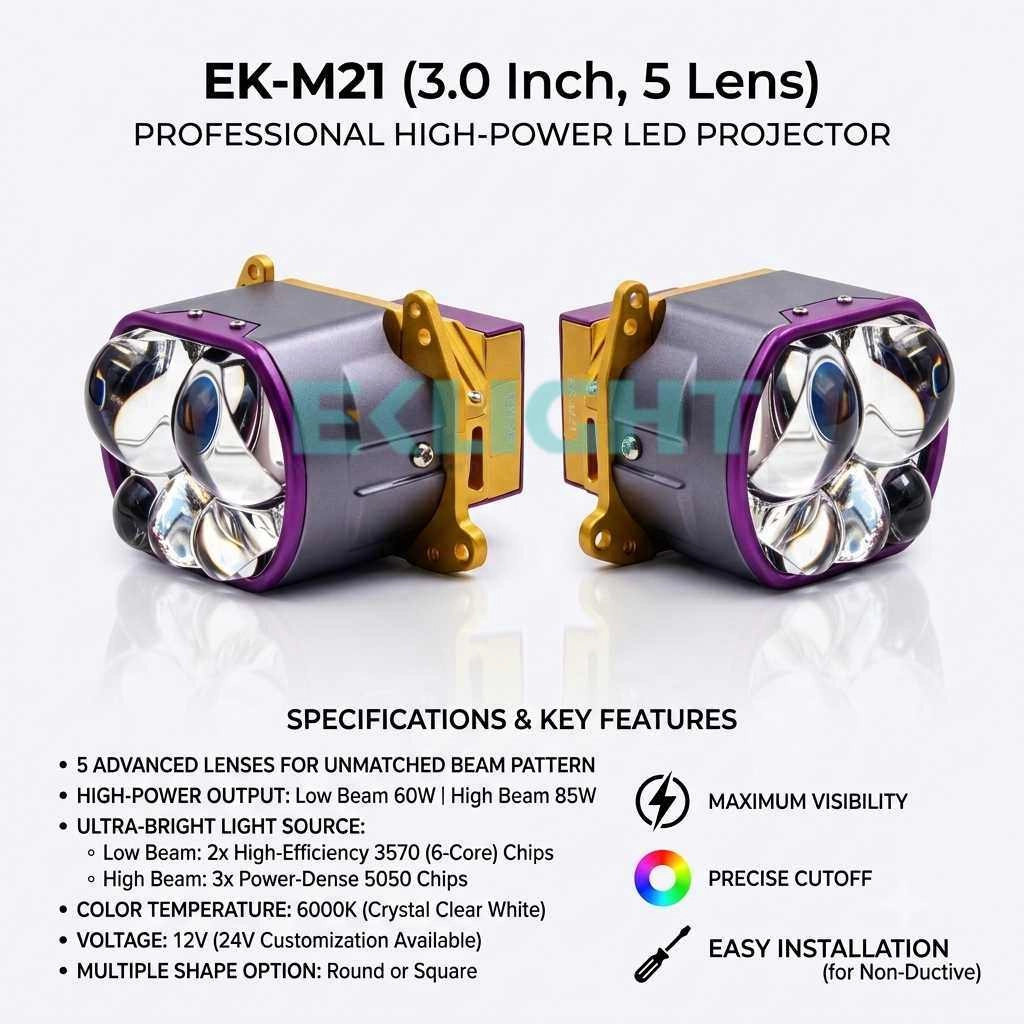
EK21 3.0-Inch Bi-LED Projector Lens 60W/85W | Factory Supply
EK21 3.0-Inch Bi-LED Projector Lens 60W/85W | Factory Supply
U10S Canbus HID Ballast – 35W / 55W Error-Free Xenon HID Bulbs
U10S Canbus HID Ballast – 35W / 55W Error-Free Xenon HID BulbsDon’t Miss Our Latest Insights
Enjoying this article?
Subscribe to receive more industry insights, product updates, and automotive lighting innovations from EKLIGHT.
Stay informed and ahead of the market.
EKLIGHT delivers innovative, high-quality LED lighting solutions trusted by global partners.
We empower businesses with reliable products that enhance performance and drive success.
Contact EKLIGHT
Address : Building C, Dehuiwanggang Industrial Zone, No. 38 Wanggang Industrial three road, Baiyun district, Guanghzou, Guangdong province, China.
© 2026 EKLIGHT. All Rights Reserved.
EKLIGHT
EK
EK
EK
EK