


Fog Light Lens Buying Guide for B2B Sourcing
Follow us now:
Sourcing a fog light lens for distribution, retrofit programs, or automotive lighting projects involves more than comparing wattage, lumen figures, or unit price. Optical performance, installation space, electrical integration, thermal behavior, environmental requirements, production consistency, and target-market requirements all affect whether a product is suitable for a specific application.
For B2B buyers, the process starts with a defined vehicle, housing, or lighting application. Technical requirements can then be converted into measurable specifications for sample evaluation, supplier comparison, quality control, and production approval.
Key Takeaways
- ●Define the vehicle, housing, and required lighting function before comparing products.
- ●Evaluate beam distribution under consistent conditions rather than relying on lumen values alone.
- ●Confirm complete dimensions, mounting geometry, rear clearance, and electrical requirements before volume purchasing.
- ●Review thermal, environmental, and production requirements together with optical performance.
- ●Establish measurable sample and production acceptance criteria before confirming a sourcing program.
What Is a Fog Light Lens?
The term “fog light lens” can describe an optical lens or, in some supplier catalogs, a more complete projector-style fog-light module. The terminology alone does not establish what is included in the supplied product.
A quotation may cover only an optical component, or it may refer to an assembly containing a lens, reflector, LED source, driver, housing, mounting hardware, wiring, or beam-control components. Buyers need to identify the actual product scope before comparing quotations from different suppliers.
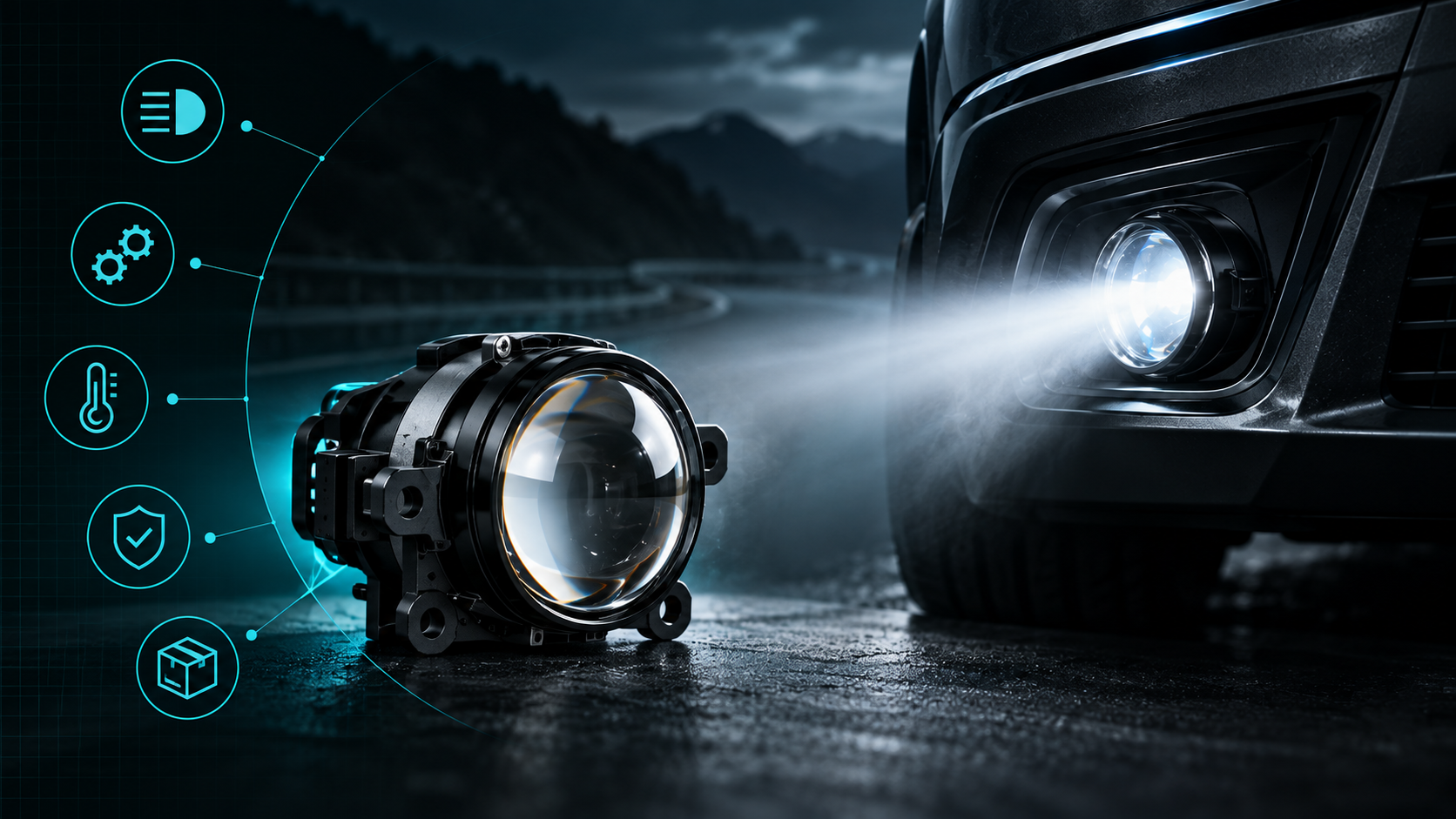
A projector-style fog light uses optical components to control the shape and direction of emitted light. The resulting beam depends on the relationship between the light source, optical geometry, component alignment, housing, and installation position.
Comparing products only by LED chip type, power rating, or nominal lumen output provides an incomplete basis for procurement. Source position, optical alignment, thermal behavior, and mounting conditions can produce different beam characteristics even when headline electrical specifications appear similar.
Fog Light Projector and Conventional Fog Light Architectures
Fog-light assemblies can use different optical structures depending on available installation space, required lamp function, vehicle design, and market requirements.
A projector architecture controls light through a defined optical system. Other fog-light assemblies may use reflector-based structures or different combinations of light sources and optics. Neither architecture should be evaluated from its name alone.
For procurement teams, the relevant comparison is whether the product delivers the required beam characteristics within the available installation envelope while meeting mounting, electrical, thermal, and documentation requirements.
A compact projector may suit an application with restricted front aperture space, while another housing design may require a different optical arrangement. Physical installation and controlled optical evaluation provide a stronger basis for selection than treating one architecture as universally preferable.
What Specifications Should Buyers Check Before Sourcing a Fog Light Lens?
A sourcing specification should connect product characteristics with the intended application. This helps engineering and purchasing teams compare products against the same requirements.
Descriptions such as “high output” or “universal fit” should be supported by measurable specifications and application-specific validation. A nominal specification cannot replace dimensional confirmation or testing in the intended installation.
How Should Buyers Evaluate Fog Light Beam Pattern?
Usable illumination depends on where light is distributed rather than on total light output alone. Beam evaluation can consider lateral spread and vertical distribution together with hotspot position, cutoff behavior where applicable, stray light, glare, uniformity, and consistency between samples.
How Do Size and Fitment Affect Fog Light Lens Selection?
Nominal lens diameter is only one part of fitment. A 2-inch module, for example, may fit the visible opening while creating interference behind the housing.
Before approving a sample, buyers should check:
- ●Lens or module diameter and complete depth
- ●Rear heatsink, driver, connector, and wiring clearance
- ●Mounting-hole pattern or threaded mounting dimensions
- ●Adjustment range and available aiming space
- ●Housing, bumper, bezel, and surrounding component clearance
Physical validation becomes particularly important in compact installations because small dimensional differences can affect mounting position, thermal clearance, connector access, or beam alignment.
Dimensional and installation considerations are also reflected in EKLIGHT's compact projector module sizing and housing clearance, including housing space, mounting geometry, thermal considerations, and electrical integration.
For vehicle-specific sourcing, dimensional drawings and physical sample fitting provide a stronger basis for compatibility assessment than nominal lens diameter alone.
How Should Buyers Compare 3000K and 6000K Fog Light Configurations?
Color temperature changes the visual appearance of emitted light, but it should be evaluated as part of the complete optical system.
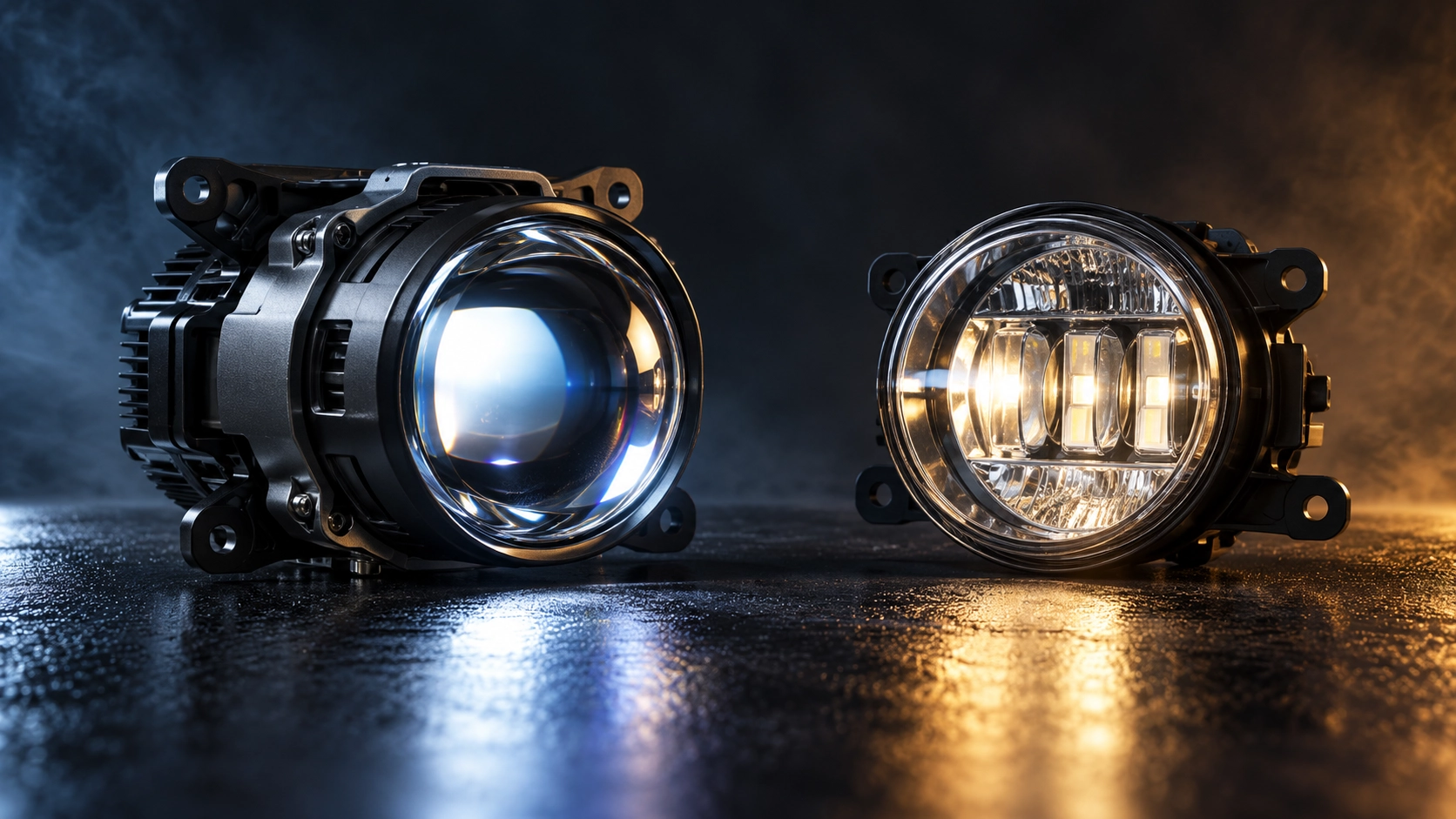
A 3000K configuration produces a warmer, yellow appearance, while a 6000K configuration produces a cooler white appearance. The sourcing decision should consider the intended application, optical performance, customer requirements, switching architecture, and requirements in the destination market.
The Kelvin value does not establish beam quality. A product still needs to be assessed for light distribution, electrical behavior, thermal performance, and consistency.
Dual-Color and Multi-Color Configurations
Selectable-color products introduce additional electrical and control considerations. Buyers should verify which modes are available, how switching is controlled, how the product behaves after restart, and whether beam performance remains consistent across the intended operating modes.
The EKLIGHT 2.0-inch dual-color Bi-LED projector fog light is an example of a product configuration listing 3000K and 6000K settings; exact electrical and photometric performance should be confirmed from the model specification and tested sample. Its dual-color Bi-LED fog light projector configuration provides a current product reference for evaluating fog light color temperature options.
Product-specific functions should be confirmed against the specification for the intended order rather than generalized across other fog-light products.
How Do Bi-LED and LED Fog Light Configurations Differ?
“LED” and “Bi-LED” describe product architectures and functions rather than quality grades. A purchasing decision should focus on what the module actually does and how it integrates into the intended application.
A Bi-LED configuration can incorporate multiple beam states or functions within an integrated optical system. The exact implementation varies by product, so buyers need to verify the beam functions, switching mechanism, electrical connections, module dimensions, mounting method, and thermal structure of the specific unit being evaluated.
Different Bi-LED and LED fog light configurations may suit different projects depending on available space, required beam function, vehicle electrical architecture, and installation method. The comparison becomes more useful when both options are evaluated against the same application requirements rather than product naming or isolated output claims.
Why Does Thermal Management Matter in LED Fog Light Systems?
LED lighting converts part of its electrical input into heat. That heat needs to move away from the LED source and electronic components to support stable operation.
Thermal behavior depends on the complete system, including the heat-transfer path, thermal interface, heatsink, driver location, enclosure conditions, and available airflow. Some designs may also use active cooling or thermal protection strategies.
Compact fog-light housings can create additional constraints because rear clearance and airflow may be limited. Open-bench testing may therefore produce different thermal conditions from operation inside a restricted or sealed housing.
For procurement purposes, thermal and waterproofing requirements for fog light lenses should be evaluated under conditions that represent the intended installation as closely as practical.
Environmental Protection and Sealing
Fog-light assemblies can be exposed to moisture, dust, vibration, road contamination, and temperature changes. Environmental requirements should be defined according to the installation and intended market rather than assumed from the product category.
Housing seals, connector interfaces, cable entry points, materials, and assembly quality can all affect environmental performance. Where a project requires water-ingress, dust, vibration, or temperature validation, buyers should request evidence that corresponds to the specific product.
An IP rating or similar environmental statement should not be generalized from one product to another. Company-level certifications should also not be treated as proof that every fog-light module carries the same product-specific approval.
How Should Importers Inspect Fog Light Lens Quality?
Quality control begins during product qualification. Waiting until a shipment arrives makes specification disagreements harder to resolve.
The first stage is specification review. Dimensions, optical function, color configuration, electrical requirements, mounting, markings, packaging, and required documents should be agreed before sample approval.
Sample evaluation then establishes whether the proposed configuration meets the project requirements. Physical fit, beam behavior, electrical operation, switching functions where applicable, thermal behavior, appearance, and connector security can be evaluated under defined conditions.
Production approval should convert the accepted sample into measurable criteria. A physical reference sample is useful, but written tolerances and test conditions provide a clearer basis for repeat production.
Batch inspection can then compare production units with the approved requirements. Structured production quality checks for fog light lenses reduce dependence on subjective visual judgment and give buyers a clearer basis for recording deviations.
Fog Light Lens Sample Inspection
Acceptance limits should reflect the intended product and application. A generic inspection form cannot establish suitable tolerances for unrelated lighting products.
How Should Buyers Evaluate a Fog Light Lens Supplier?
Supplier evaluation should establish whether an approved product configuration can be supported with repeatable production and clear technical communication.
Specification control is a useful starting point. Buyers need enough information to identify the exact configuration being quoted, including dimensions, optical functions, electrical requirements, mounting details, and supplied components.
Dimensional information can then be checked against the intended housing. Where fitment tolerances are tight, drawings and physical samples provide additional evidence before volume purchasing.
Optical information also needs context. Beam photographs or test data become more useful when the input conditions, mounting position, aiming method, and other relevant test parameters are known.
Sample consistency provides another indication of production control. Differences in beam alignment, color, dimensions, current draw, switching operation, or finish can reveal areas that require tighter acceptance criteria.
Change control also matters after approval. Changes to LEDs, drivers, optical components, connectors, materials, or manufacturing processes may affect characteristics that were previously validated. Purchasing agreements can define how relevant changes are communicated and reviewed.
Documentation requirements depend on the product and destination market. Certification or testing associated with one product should not automatically be assumed to apply to another product. A structured set of supplier qualification criteria for fog light sourcing can keep these checks connected to the same purchasing decision.
What Should Buyers Include in a Fog Light Lens RFQ?
The inquiry should distinguish a bare optical lens, a complete fog-light projector module and a ready-to-install assembly. Buyers should also request the exact model or revision and clarify whether the stated environmental and compliance documents apply to the quoted configuration.
A structured RFQ reduces ambiguity and makes supplier quotations easier to compare. The request should describe the intended application rather than relying only on a product image or a short keyword.
- ●Vehicle, housing, intended lighting application, and destination market
- ●Available diameter, depth, mounting space, and adjustment requirements
- ●Beam, color-temperature, electrical, connector, and switching requirements
- ●Environmental, testing, and product-documentation requirements
- ●Quantity, packaging, labeling, and branding requirements
These fog light lens RFQ requirements give the supplier a defined technical scope for quotation and sample preparation.
If some specifications have not yet been finalized, they can be identified as open items. Keeping unresolved requirements visible is preferable to allowing different assumptions to enter quotations.
How Should Buyers Compare Fog Light Lens Quotations?
A comparable quotation should specify the same optical variant, housing and mounting geometry, driver and wiring configuration, approved sample revision, packaging and inspection scope. If one quote excludes the mounting kit, verification records or required test samples, its unit price is not directly comparable with a fully specified offer.
Unit prices become meaningful only when suppliers are quoting comparable technical scopes.
A lower unit quotation can still result in additional project costs if adapters, wiring components, testing, installation work, packaging changes, or rework are required later.
A useful commercial comparison combines unit cost with technical scope, validation requirements, and implementation responsibilities.
Fog Lights Within a Complete Forward-Lighting System
Fog lights may operate alongside headlights, auxiliary lamps, or driving lights. When several forward-lighting components are used on the same vehicle, their functions should be evaluated together.
Beam overlap, aiming, mounting position, electrical load, switching logic, color configuration, and intended lamp function can influence the combined system.
EKLIGHT's LED headlight and fog light coordination information covers considerations for vehicle setups that use multiple forward-lighting components.
System-level evaluation helps purchasing and engineering teams avoid treating individual lighting components as isolated products when their installation or operation is interconnected.
Fog Light Lens Buyer Checklist
- ●Application, target market, lamp function, and required optical performance
- ●Module dimensions, installation space, mounting geometry, and adjustment range
- ●Color configuration, electrical requirements, connectors, and thermal conditions
- ●Environmental requirements, required testing, and product-specific documentation
- ●Sample acceptance criteria, production tolerances, quantity, packaging, labeling, and branding
Any unresolved requirement should be identified before production so the buyer and supplier can confirm responsibilities and acceptance criteria.
FAQ
What is a fog light lens?
A fog light lens is an optical component used to shape or distribute light within a fog-light system. Supplier terminology may also use the term for a more complete projector module, so buyers should confirm the supplied product scope.
What should B2B buyers check before sourcing a fog light lens?
Key areas include beam characteristics, dimensions, fitment, mounting, color configuration, electrical integration, thermal design, environmental requirements, sample consistency, product documentation, and target-market requirements.
How should a fog light beam pattern be evaluated?
Use consistent test conditions and examine light distribution, cutoff behavior where applicable, hotspot position, stray light, glare, and sample consistency against the intended lamp function.
How do 3000K and 6000K fog light configurations differ?
A 3000K configuration has a warmer yellow appearance, while 6000K has a cooler white appearance. Buyers should also consider beam performance, switching architecture, electrical behavior, application requirements, and destination-market requirements.
How can buyers confirm fog light lens fitment?
Check complete module dimensions, mounting geometry, rear clearance, connector position, thermal components, wiring space, and adjustment range, and use physical sample testing where appropriate.
What is a Bi-LED fog light module?
A Bi-LED module generally combines LED illumination with an optical structure capable of providing multiple beam states or functions. The exact implementation should be verified for the specific module.
What quality documents should buyers request?
Relevant records may include product specifications, dimensional drawings, agreed test information, sample-approval records, inspection criteria, and product-specific compliance documentation required for the destination market.
What should be included in a fog light lens RFQ?
An RFQ should identify the application, target market, dimensions, optical requirements, color configuration, electrical requirements, mounting conditions, environmental requirements, estimated quantity, required documentation, packaging, and branding requirements.
- Quick Answer: What Should Buyers Check When Sourcing a Fog Light Lens?
- Key Takeaways
- What Is a Fog Light Lens?
- Fog Light Projector and Conventional Fog Light Architectures
- What Specifications Should Buyers Check Before Sourcing a Fog Light Lens?
- How Should Buyers Evaluate Fog Light Beam Pattern?
- Beam Width and Distribution
- Cutoff and Glare Control
- Lumen Output and Usable Light
- Consistent Test Conditions
- How Do Size and Fitment Affect Fog Light Lens Selection?
- How Should Buyers Compare 3000K and 6000K Fog Light Configurations?
- Dual-Color and Multi-Color Configurations
- How Do Bi-LED and LED Fog Light Configurations Differ?
- Why Does Thermal Management Matter in LED Fog Light Systems?
- Environmental Protection and Sealing
- How Should Importers Inspect Fog Light Lens Quality?
- Fog Light Lens Sample Inspection
- How Should Buyers Evaluate a Fog Light Lens Supplier?
- What Should Buyers Include in a Fog Light Lens RFQ?
- How Should Buyers Compare Fog Light Lens Quotations?
- Fog Lights Within a Complete Forward-Lighting System
- Fog Light Lens Buyer Checklist
- Preparing a Fog Light Lens Sourcing Specification
- FAQ

Eco-Bright Driving: High Performance & Savings of Next-Gen Fanless LED Headlights
Bi-LED vs LED Fog Light Lens: What Should B2B Buyers Compare?
Contacts
EKLIGHT
WhatsApp/Phone

H11 LED Headlight Bulbs for Projector Headlamps | Wholesale
H11 LED Headlight Bulbs for Projector Headlamps | Wholesale
Best Auto Led Headlights | Custom Car Led Headlights
Best Auto Led Headlights | Custom Car Led Headlights
T15 912/921 High-Power CANbus LED Reverse Light Bulbs | Wholesale
T15 912/921 High-Power CANbus LED Reverse Light Bulbs | Wholesale
EK-V2 Fan-Cooled HGL3 5530 LED Headlight Bulbs H4/H7/H11/9006 | OEM
EK-V2 Fan-Cooled HGL3 5530 LED Headlight Bulbs H4/H7/H11/9006 | OEMDon’t Miss Our Latest Insights
Enjoying this article?
Subscribe to receive more industry insights, product updates, and automotive lighting innovations from EKLIGHT.
Stay informed and ahead of the market.
EKLIGHT delivers innovative, high-quality LED lighting solutions trusted by global partners.
We empower businesses with reliable products that enhance performance and drive success.
Contact EKLIGHT
Address : Building C, Dehuiwanggang Industrial Zone, No. 38 Wanggang Industrial three road, Baiyun district, Guanghzou, Guangdong province, China.
© 2026 EKLIGHT. All Rights Reserved.
EKLIGHT
EK
EK
EK
EK