


Bi-LED vs LED Fog Light Lens: What Should B2B Buyers Compare?
Follow us now:
Compare optical functions, module compatibility, and verifiable supplier evidence.
Bi-LED is a type of LED-based optical module, not an alternative light-source technology to LED. In supplier catalogs, the term commonly refers to a projector with two beam functions, while an “LED fog light lens” may describe a dedicated fog-light module, a lens component or a complete assembly. Confirm the actual functions and supplied components for each quoted model.
For B2B buyers, the purchasing decision should be based on required beam functions, optical performance, fitment, electrical integration, thermal design, switching behavior where applicable, and sample validation rather than the technology name alone.
Key Takeaways
What Does Bi-LED Mean in a Fog-Light Projector?
In automotive projector terminology, Bi-LED generally refers to an LED-based optical system designed to provide two beam functions within one projector assembly. The exact optical and mechanical implementation varies by product, so buyers should confirm how the required functions are created and controlled rather than assume that every Bi-LED module uses the same structure.
From a procurement perspective, the important issues are functional. Buyers need to know which beam modes are available, how switching is controlled, what electrical connections are required, whether the operating modes match the intended vehicle application, and how the optical result behaves during sample testing.
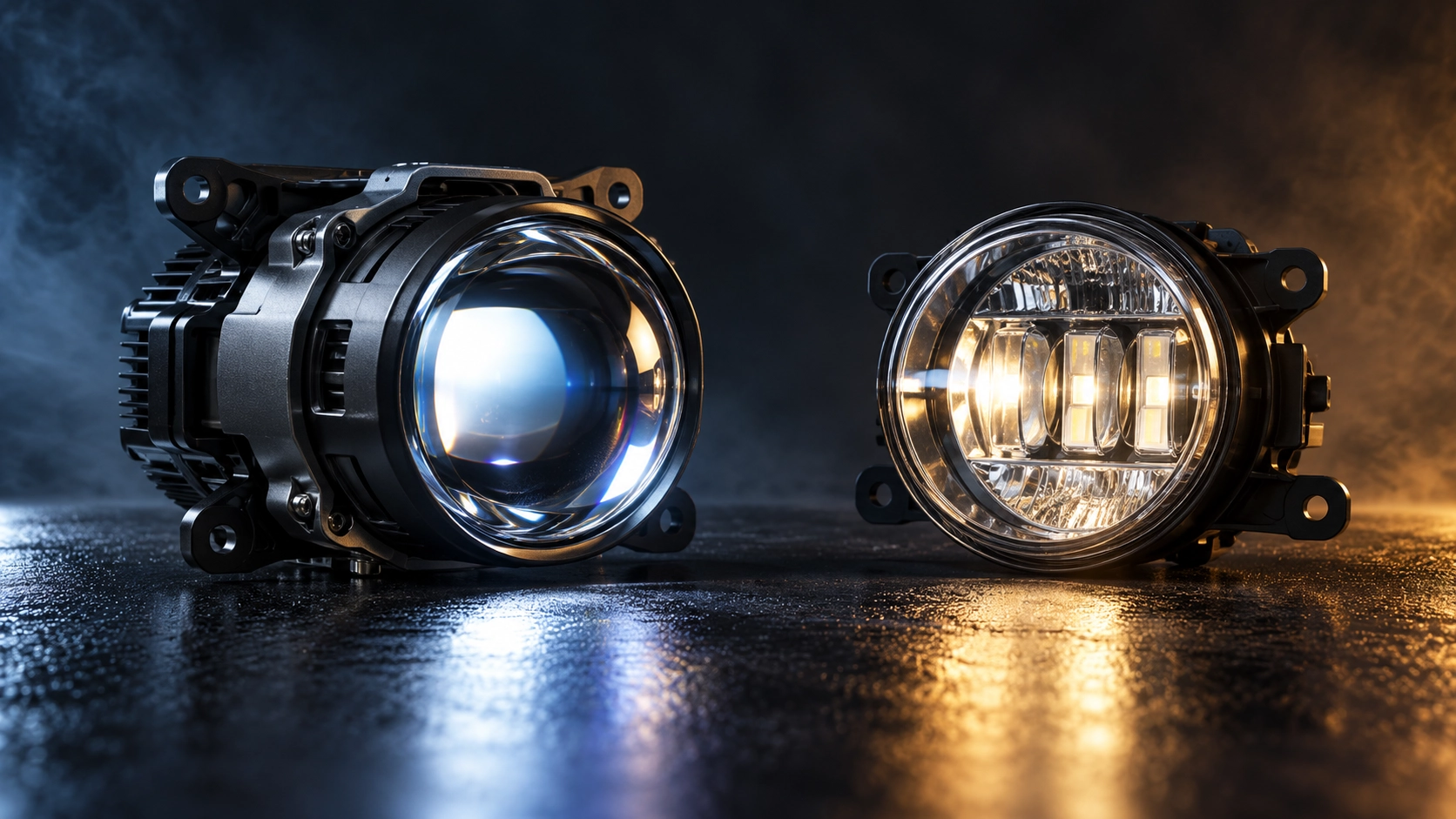
EKLIGHT currently lists a 2.0-inch 3000K/6000K Bi-LED projector fog-light configuration with 35W/45W specifications. Those parameters belong to that specific product and should not be treated as specifications for every Bi-LED fog-light lens.
What Does LED Fog Light Lens Mean?
“LED fog light lens” is a broader sourcing term. It identifies an LED-based fog-light optical product but does not, by itself, define the number of beam functions, the optical layout, the mounting structure, or the electrical architecture.
An LED fog-light product may be developed around a dedicated fog-light function. Other designs may combine additional functions or use different optical structures. For buyers comparing supplier quotations, the product definition therefore needs to go beyond a short technology label.
Useful fog light lens sourcing criteria include the intended application, required beam function, installation envelope, optical acceptance points, electrical requirements, color configuration, sample conditions, and destination-market requirements. These criteria establish a more reliable comparison basis than terminology alone.
Bi-LED vs LED Fog Light Lens: Procurement Comparison
| Procurement Factor | Bi-LED Configuration | LED Fog-Light Configuration |
|---|---|---|
| Beam function | May integrate two beam functions | May focus on a dedicated fog-light function |
| Switching | Confirm switching method and control requirements | Depends on the specific design |
| Optical approval | Evaluate every required beam mode | Evaluate the specified fog-light function |
| Fitment | Check complete projector envelope and associated components | Check the complete product structure and mounting space |
| RFQ definition | Specify beam modes and switching requirements | Specify the required optical function |
Does Bi-LED Automatically Mean Stronger Beam Performance?
No. The number of available beam functions and the quality of the optical result are separate considerations. A Bi-LED projector can provide additional functionality, but each required mode still needs to be evaluated against the sourcing specification.
Relevant optical checks can include beam distribution, hotspot position, uniformity, alignment, stray light, glare control, and cutoff behavior where a defined cutoff forms part of the design. The observed result can also be affected by mounting position, aiming, supply conditions, operating time, and the test setup.
B2B approval therefore benefits from a separate beam pattern and cutoff evaluation. A technology name should not replace direct inspection of the actual sample.
How Does the Required Beam Function Affect the Choice?
The product brief should define the required operating function before the optical architecture is selected. If a program only requires a dedicated fog-light beam, an additional beam mode may not contribute to the intended application. If multiple beam functions are genuinely required within one module, a suitable Bi-LED architecture can become relevant.
Additional functions can also affect wiring, control logic, installation instructions, sample testing, packaging information, and after-sales troubleshooting. For sourcing teams, each extra function should therefore correspond to an identified product requirement.
Instead of sending an RFQ that only states “Bi-LED,” buyers can define the required operating modes and expected behavior. This makes it easier to determine whether different suppliers are quoting equivalent products.
What Should Buyers Inspect in the Beam Pattern?
Optical comparison should be performed on the actual sourcing samples. Buyers can examine horizontal and vertical light distribution, hotspot location, unwanted stray light, glare control, alignment, and the repeatability of the result. Where the product design includes a defined cutoff, its position and consistency can also be recorded.
Consistent test conditions are important when comparing suppliers. Mounting, aiming, supply voltage, operating duration, measurement distance, and the surrounding test environment should be controlled closely enough that product differences are not confused with setup differences.
Beam spread is another useful optical consideration. EKLIGHT already has technical content covering fog light beam width and distribution, which can support the broader optical evaluation process.
How Do Fitment and Housing Space Affect the Decision?
Optical architecture is only useful when the module can be integrated into the intended housing. Buyers should evaluate the complete installation envelope rather than rely only on a nominal lens diameter.
Relevant fitment factors can include projector depth, mounting points, rear clearance, connector position, driver location, heatsink geometry, wiring space, adjustment requirements, and available thermal clearance.
For applications where packaging space is restricted, projector module dimensions and fitment limits deserve separate review. Dimensional drawings or confirmed dimensions for the exact candidate product should be checked before fitment approval.
What Changes When Beam Switching Is Required?
If a Bi-LED configuration uses a mechanism or control method to change beam function, that operating system becomes part of sample validation. Buyers can confirm how switching is triggered, the required electrical interface, the behavior of each mode, and repeatability during repeated operation.
This does not mean that an additional mechanism should automatically be treated as a reliability weakness. It means that an added function introduces another operating condition that needs a defined acceptance method. Supplier quotations should describe the switching requirement clearly enough that purchasing teams are comparing equivalent configurations.
How Should Thermal and Sealing Requirements Be Evaluated?
LED light sources and associated electronics generate heat during operation. For either architecture, buyers can review the heat path, heatsink arrangement, driver position, surrounding installation space, and the product's behavior after reaching a stable operating condition.
The same evidence-based approach applies to sealing. Required environmental protection should be defined according to the actual sourcing project, then verified against product-specific documentation and agreed test requirements rather than inferred from a technology category.
thermal and waterproofing requirements for fog light lenses should remain an independent procurement topic because two products using similar optical terminology can have different mechanical and environmental designs.
Does Color Temperature Determine the Optical Architecture?
No. Color temperature and optical architecture describe different parts of the sourcing specification. A buyer may require 3000K, 6000K, or another confirmed color configuration depending on the product program, but that requirement does not by itself determine whether the module should use a Bi-LED architecture.
The fog light color configuration should therefore be evaluated alongside beam function rather than used as a substitute for it. When multiple color modes and multiple beam functions exist in the same product, both dimensions should be recorded during sample approval.
Otherwise, two quotations can appear similar at first glance while describing different switching logic, color modes, beam functions, or electrical requirements.
How Should B2B Buyers Approve Samples?
Sample approval should begin with the exact configuration being quoted. A practical sequence is:
1. Confirm the configuration. Record the product version, beam functions, color configuration, electrical conditions, mounting requirements, and switching requirements where applicable.
2. Control the test conditions. Use sufficiently consistent mounting, aiming, supply, operating time, and optical evaluation conditions.
3. Evaluate every required operating mode. A Bi-LED sample should be checked in each mode specified by the sourcing project.
4. Preserve the approved reference. Keep the approved product configuration identifiable so later production quality checks for fog light lenses can compare production units against an agreed reference.
What Should Buyers Include in the RFQ?
Clear fog light lens RFQ requirements reduce the risk of comparing products with different functions. The RFQ can define the intended application, required beam function, installation space, mounting method, electrical requirements, color configuration, optical acceptance points, sample requirements, packaging, labeling, and destination market.
For a Bi-LED configuration, the required beam modes and switching method should also be defined. If the quotation is for another LED fog-light configuration, the required optical function should still be explicit.
Before comparing prices, buyers should confirm that suppliers have quoted equivalent configurations. A price difference has limited meaning when the quoted products differ in beam function, size, control method, color configuration, or installation requirements.
How Should Buyers Make the Final Selection?
Start with the required function. If the product program needs multiple beam modes within one module and the related switching architecture, evaluate Bi-LED candidates against those requirements. If the project requires a dedicated fog-light function, evaluate LED fog-light candidates that match that defined optical and integration requirement.
Then compare the actual products rather than the labels. Beam behavior, fitment, electrical integration, thermal management, switching where applicable, sample consistency, documentation, and destination-market requirements should remain separate approval items.
Approve the configuration that meets the required fog-light function and can be specified, tested, quoted, and reproduced consistently across production batches.
B2B Sample Comparison and Approval Record
Assess the exact quoted model and supplied scope under consistent test conditions. A product labeled Bi-LED should only receive credit for beam functions that have been demonstrated on the sample; a dedicated LED fog-light module should be judged against its intended fog-light function rather than an unneeded high-beam feature.
| Approval area | Comparable evidence |
|---|---|
| Functions & switching | Defined beam modes, switching input and return-position consistency, if applicable |
| Optical result | Beam spread, upper-light control, hotspot and measured distribution at fixed aim and supply voltage |
| Installation | Body dimensions, mounting, driver location, wiring, sealed housing and aiming range |
| Operating stability | Warm-state performance, driver behavior and thermal / ingress evidence tied to the model |
| Commercial approval | Approved sample revision, acceptance criteria, testing responsibility, quantity and included accessories |
Lighting regulations and acceptable beam functions differ by market. A fog-lamp assembly with additional beam modes cannot be presumed legal for every road-use application merely because it physically fits or has an advertised certification.
Define the Required Fog-Light Configuration Before Quotation
EKLIGHT's current automotive lighting range includes LED products and Bi-LED projector solutions. Buyers can define the required optical function, installation envelope, color configuration, electrical requirements, sample criteria, and destination-market requirements before requesting a quotation.
FAQ
What is the difference between a Bi-LED and LED fog light lens?
A Bi-LED configuration generally integrates two beam functions within a projector system, while LED fog light lens is a broader term that does not by itself define the number of beam functions or complete optical architecture.
Is a Bi-LED fog light lens better than an LED fog light lens?
Not universally. The suitable configuration depends on required beam functions, optical performance, fitment, electrical integration, thermal design, and the sourcing project's acceptance criteria.
Does Bi-LED automatically produce a better beam pattern?
No. Beam quality depends on the actual optical design and should be evaluated through the relevant beam distribution, cutoff, glare, alignment, and consistency criteria.
When should B2B buyers consider a Bi-LED fog-light configuration?
It can be considered when the product program requires integrated beam functions and the associated switching architecture. The actual product should still be validated against project requirements.
What should buyers test in a Bi-LED fog-light sample?
Buyers can evaluate all required beam modes, switching behavior, optical distribution, fitment, electrical operation, thermal behavior, and consistency under defined test conditions.
Does color temperature determine whether to choose Bi-LED or LED?
No. Color temperature and optical architecture are separate specification dimensions and should be evaluated independently.
What should an RFQ specify for a fog light lens?
An RFQ can define application, beam function, fitment, electrical requirements, color configuration, optical acceptance requirements, switching requirements where applicable, samples, packaging, labeling, and destination market.
- Key Takeaways
- What Does Bi-LED Mean in a Fog-Light Projector?
- What Does LED Fog Light Lens Mean?
- Bi-LED vs LED Fog Light Lens: Procurement Comparison
- Does Bi-LED Automatically Mean Stronger Beam Performance?
- How Does the Required Beam Function Affect the Choice?
- What Should Buyers Inspect in the Beam Pattern?
- How Do Fitment and Housing Space Affect the Decision?
- What Changes When Beam Switching Is Required?
- How Should Thermal and Sealing Requirements Be Evaluated?
- Does Color Temperature Determine the Optical Architecture?
- How Should B2B Buyers Approve Samples?
- What Should Buyers Include in the RFQ?
- How Should Buyers Make the Final Selection?
- B2B Sample Comparison and Approval Record
- Define the Required Fog-Light Configuration Before Quotation
- FAQ
Do LED Headlights Really Need Fans?
Beyond Brightness: The Rise of LED Projector Lens Miniaturization
Contacts
EKLIGHT
WhatsApp/Phone
EK-G2 CANbus LED Decoder and Anti-Flicker Harness | OEM Wholesale
EK-G2 CANbus LED Decoder and Anti-Flicker Harness | OEM Wholesale
EK-C4 Series 5-Sided LED Bulb 12.5W High Power 1860 Chips
EK-C4 Series 5-Sided LED Bulb 12.5W High Power 1860 Chips
EK-V1 Fanless HGL3 5530 LED Headlight Bulbs H4/H7/H11/9005 | Wholesale
EK-V1 Fanless HGL3 5530 LED Headlight Bulbs H4/H7/H11/9005 | Wholesale
Don’t Miss Our Latest Insights
Enjoying this article?
Subscribe to receive more industry insights, product updates, and automotive lighting innovations from EKLIGHT.
Stay informed and ahead of the market.
EKLIGHT delivers innovative, high-quality LED lighting solutions trusted by global partners.
We empower businesses with reliable products that enhance performance and drive success.
Contact EKLIGHT
Address : Building C, Dehuiwanggang Industrial Zone, No. 38 Wanggang Industrial three road, Baiyun district, Guanghzou, Guangdong province, China.
© 2026 EKLIGHT. All Rights Reserved.
EKLIGHT
EK
EK
EK
EK