


Top 10 car led headlight bulbs manufacturers and suppliers
- Key Takeaways
- Start With the Automotive Lighting Supply Chain
- What Type of LED Headlight Supplier Do You Need?
- 10 Automotive LED Headlight Companies Buyers May Compare
- How Should B2B Buyers Evaluate a Car LED Headlight Bulb Manufacturer?
- Beam Pattern Matters More Than a Headline Lumen Number
- Fitment Includes More Than the Bulb Base
- Fanless vs Fan-Cooled LED Headlight Bulbs
- Treat CANbus Compatibility as Vehicle-Specific
- What Technical Documents Should Buyers Request?
- Regulatory Requirements Depend on Product and Market
- OEM Headlamp Supplier vs Aftermarket LED Bulb Manufacturer
- How EKLIGHT Supports B2B LED Headlight Bulb Sourcing
- What Should Buyers Include in an LED Headlight Bulb RFQ?
- Compare Quotations Only After the Technical Scope Matches
- Compare the Product Before Comparing the Supplier Name
- Define Your LED Headlight Bulb Requirements With EKLIGHT
- Common Buyer Questions
Key Takeaways
Start With the Automotive Lighting Supply Chain
Search results for car LED headlight bulb manufacturers often bring together companies from several different parts of the automotive lighting industry.
Some companies focus on finished replacement lamps. Some develop complete headlamp systems for vehicle manufacturers. Others provide LEDs, drivers, light-source modules, or other components used inside a lighting product.
For distributors, importers, retrofit programs, private-label projects, and replacement-parts businesses, sourcing usually puts more emphasis on fitment, optical behavior, cooling structure, electrical compatibility, vehicle application, packaging, and repeatability between production units.
What Type of LED Headlight Supplier Do You Need?
10 Automotive LED Headlight Companies Buyers May Compare
The companies below represent different positions in the automotive lighting supply chain. The order is not a performance ranking, and not every company is a direct alternative to an aftermarket LED headlight bulb manufacturer.
1. Philips Automotive
Philips Automotive is associated with automotive replacement lighting and headlight products.
For B2B buyers, lamp type, intended application, fitment, electrical requirements, beam result, regulatory scope, and the exact product configuration remain more useful comparison points than brand recognition alone.
2. ams OSRAM
ams OSRAM participates at multiple levels of automotive lighting, including replacement lighting as well as LED light sources and semiconductor technologies used in vehicle lighting.
Buyers should first determine whether the requirement is a finished replacement lamp, an LED component, a module, or a technology intended for further integration.
3. FORVIA HELLA
FORVIA HELLA operates in automotive lighting systems and headlamp technologies.
Its sourcing context is closer to complete vehicle lighting and system integration than to a typical independent replacement LED bulb manufacturer.
4. Bosch
Bosch is a broad automotive technology and electronics supplier.
Buyers should verify the exact current lighting scope relevant to their project before treating Bosch as directly comparable with a specialist LED headlight bulb manufacturer.
5. Valeo
Valeo participates in automotive lighting and vehicle-system development.
Its role is generally closer to complete lighting systems and vehicle integration than to a standalone replacement LED bulb supplier.
6. KOITO
KOITO operates in automotive lighting and complete vehicle-lamp systems.
For sourcing purposes, it is more relevant to OEM headlamp architecture, optical control, lighting systems, and vehicle programs than to a straightforward replacement LED bulb comparison.
7. DENSO
DENSO is a broad automotive systems and components supplier.
Purchasing teams should confirm the actual product scope first and separate broader vehicle-system requirements from finished replacement-lighting sourcing.
8. Stanley Electric
Stanley Electric develops automotive lighting products and lamp systems.
Its sourcing context includes vehicle lighting, optical control, and system-level applications rather than a generic aftermarket bulb comparison.
9. Marelli
Marelli operates in automotive front-lighting systems and lighting technologies.
Its role can include optics, electronics, lighting functions, vehicle styling, and system integration, making it more relevant to OEM and advanced vehicle-lighting programs.
10. Lumileds
Lumileds supplies automotive LEDs and light-source technologies used in headlighting.
It occupies an upstream position in the supply chain rather than the same position as a finished retrofit LED bulb manufacturer.
How Should B2B Buyers Evaluate a Car LED Headlight Bulb Manufacturer?
Once the supplier type is clear, the next step is to compare the actual product configuration.
Beam Pattern Matters More Than a Headline Lumen Number
Total light output and useful road illumination are not the same thing. Lumen values describe emitted light under defined conditions, but they do not show where the existing headlamp optics send that light.
A replacement LED bulb with a high output claim can still produce an unsuitable beam if the emitter geometry does not work effectively with the reflector or projector.
Buyers can therefore compare beam distribution, hotspot position, cutoff behavior where relevant, alignment, unwanted stray light, glare, and sample-to-sample consistency alongside output specifications.
Fitment Includes More Than the Bulb Base
Two LED headlight bulbs can share the same nominal base and still fit differently inside a headlamp housing.
Rear depth, fan diameter, heatsink geometry, driver location, connector orientation, cable routing, and dust-cover space can all affect installation.
Buyers can begin with EKLIGHT's automotive LED headlight bulb range and narrow the candidate configuration according to the intended application, available housing space, electrical requirements, and vehicle compatibility.
Fanless vs Fan-Cooled LED Headlight Bulbs
Fanless and fan-cooled designs use different thermal approaches. Neither architecture should be treated as automatically preferable.
Buyers can compare EKLIGHT's fanless headlight bulb configurations with fan-cooled LED headlight designs according to installation space, airflow, cooling structure, driver position, and the intended operating environment.
Sample evaluation should represent the intended installation condition as closely as practical.
Treat CANbus Compatibility as Vehicle-Specific
“CANbus compatible” is often used as a broad product description, but vehicle electrical-monitoring strategies vary.
A bulb that operates without warning messages in one vehicle may behave differently in another application.
EKLIGHT provides CANbus compatibility solutions as a separate product category. A more practical sourcing process is to identify the target application first, test the proposed bulb, and determine whether an additional decoder or compatibility solution is required.
What Technical Documents Should Buyers Request?
Documentation should support the purchasing decision rather than exist only as a checklist.
A company-level certificate should not automatically be treated as evidence for every LED headlight bulb in a supplier's catalog, and a report for one configuration should not automatically be applied to another model.
Regulatory Requirements Depend on Product and Market
Automotive lighting requirements vary according to destination market, product type, original headlamp construction, application, and the exact approval scope involved.
Claims such as “ECE compliant,” “SAE compliant,” “DOT approved,” or “road legal” should be checked against the exact product and intended use. Product-specific evidence is more useful than a broad supplier-level compliance statement.
OEM Headlamp Supplier vs Aftermarket LED Bulb Manufacturer
These supplier types solve different sourcing problems.
| Comparison | OEM Headlamp System | Replacement LED Bulb |
|---|---|---|
| Product Scope | Complete lamp and vehicle integration | Replacement light source |
| Optical Context | Optics developed as part of the complete system | Must work with an existing reflector or projector |
| Fitment | Vehicle-program integration | Base, rear depth, cooling and dust-cover space |
| Electrical | Integrated vehicle system | Driver and vehicle compatibility |
How EKLIGHT Supports B2B LED Headlight Bulb Sourcing
EKLIGHT specializes in automotive LED lighting products. Its current website product range includes LED Headlight Bulbs, Fanless All-in-One LED Headlight Bulbs, Fan-Cooled LED Headlight Bulbs, CANbus Decoders, Mini Projector LED Bulbs, and Bi-LED Projector Lenses.
For distributors, importers, replacement-parts programs, and other B2B buyers, product selection can begin with the intended bulb application and installation environment.
Available housing space, cooling structure, electrical requirements, beam expectations, and vehicle compatibility can then be used to narrow the candidate configuration before sample evaluation and commercial discussion. Product-specific technical and purchasing conditions should be confirmed for the intended sourcing inquiry.
What Should Buyers Include in an LED Headlight Bulb RFQ?
A clear RFQ helps suppliers quote the correct product configuration.
Compare Quotations Only After the Technical Scope Matches
Price comparison is useful only when suppliers are quoting equivalent products.
A quotation can differ because of changes in LED source, power configuration, driver design, cooling architecture, connector, CANbus solution, accessories, packaging, documentation, or testing scope.
Before comparing price, buyers should confirm that the proposed products represent the same technical requirement.
Compare the Product Before Comparing the Supplier Name
Global lighting companies, OEM headlamp-system suppliers, LED component manufacturers, and aftermarket bulb specialists can all appear in searches for automotive LED headlights.
For replacement LED headlight bulb projects, the more practical decision is based on fitment, beam behavior, emitter geometry, thermal structure, vehicle-electronics compatibility, product-specific evidence, sample consistency, and production requirements.
Common Buyer Questions
What type of LED headlight supplier should B2B buyers choose?
The supplier type should match the sourcing requirement. Replacement LED bulb manufacturers are relevant to aftermarket and retrofit projects, while OEM headlamp-system suppliers focus on complete vehicle lighting systems. LED component suppliers provide light sources, drivers, or modules used inside lighting products. Buyers should identify the required product level before comparing suppliers.
How should buyers evaluate a car LED headlight bulb manufacturer?
Buyers can compare the exact product configuration, including bulb fitment, LED emitter position, beam performance, cooling structure, electrical requirements, vehicle compatibility, product-specific documentation, sample consistency, and production acceptance criteria. Supplier names alone do not establish product suitability.
Is lumen output enough to compare LED headlight bulbs?
No. Lumen output describes total light output under specified conditions but does not show how the light is distributed through the headlamp optics. Beam pattern, hotspot position, cutoff behavior where applicable, glare, alignment, and repeatability should also be evaluated.
How should buyers evaluate CANbus compatibility for LED headlight bulbs?
CANbus compatibility should be checked against the intended vehicle application. Vehicle electrical monitoring systems vary, so a bulb that works without warnings in one vehicle may behave differently in another. Buyers can confirm the target vehicle, test the proposed bulb, and determine whether an additional decoder or compatibility solution is required.
What technical documents should buyers request from an LED headlight bulb supplier?
Depending on the project, buyers may request product specifications, dimensional information, electrical data, optical or beam-test information, thermal information, relevant product-specific test records, applicable approval evidence, sample identification, and production acceptance references. Documentation should correspond to the exact product being sourced.
What should be included in an LED headlight bulb RFQ?
An RFQ can include the target vehicle or headlamp application, bulb type, installation space, electrical and CANbus requirements, beam expectations, cooling requirements, destination market, required documentation, sample needs, packaging, labeling, and other commercial requirements. Suppliers should identify any deviations from the requested configuration.
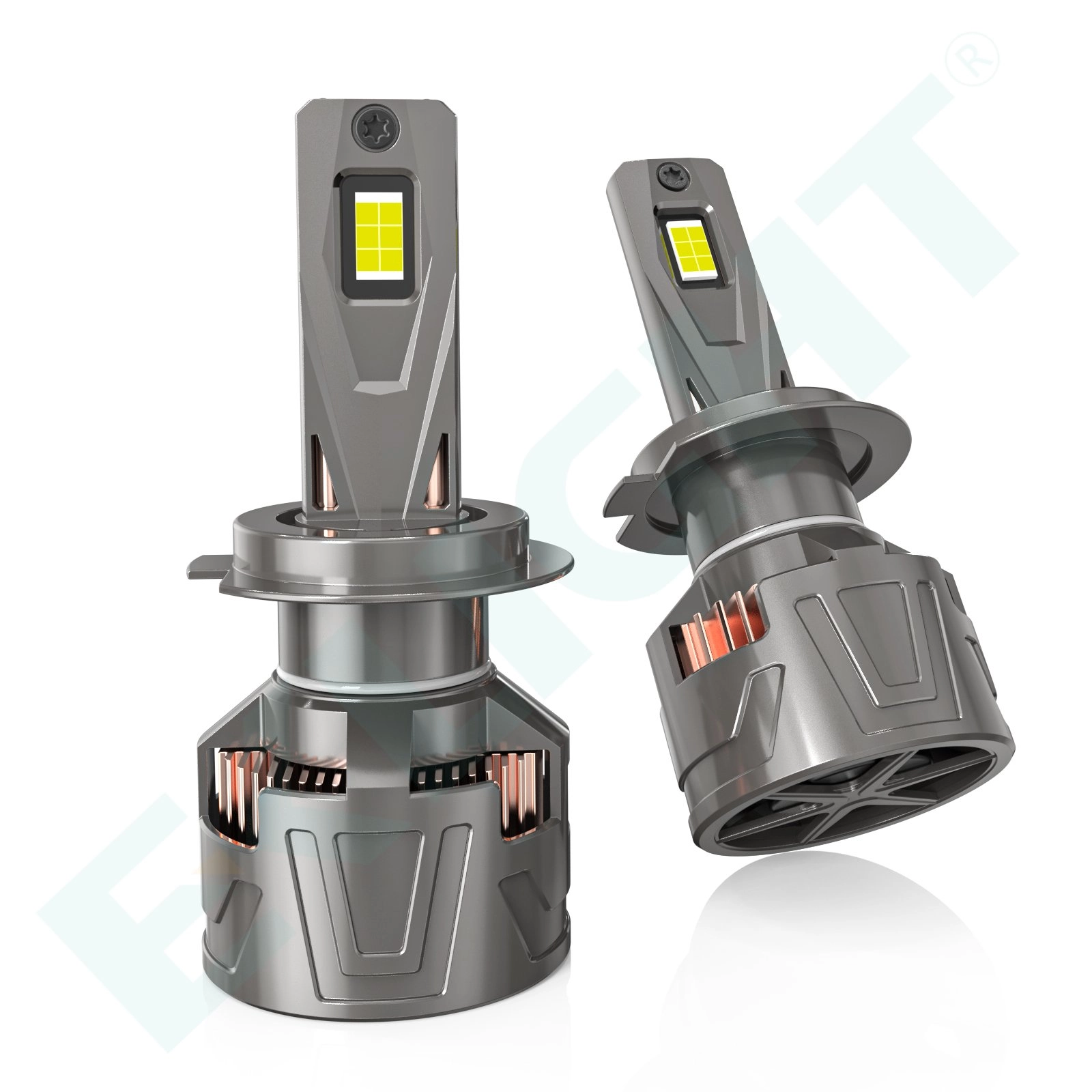
EKLIGHT EK-V90 is a fan-cooled LED headlight bulb series with six 3570 LED chips, up to 65W and 6500LM stated output, and a heat-pipe cooling design. The model incorporates a CANbus-related electrical configuration, but vehicle compatibility should be tested rather than assumed. EKLIGHT helps aftermarket distributors compare the appropriate bulb bases, installation clearance, thermal characteristics and samples for wholesale or private-label programs.
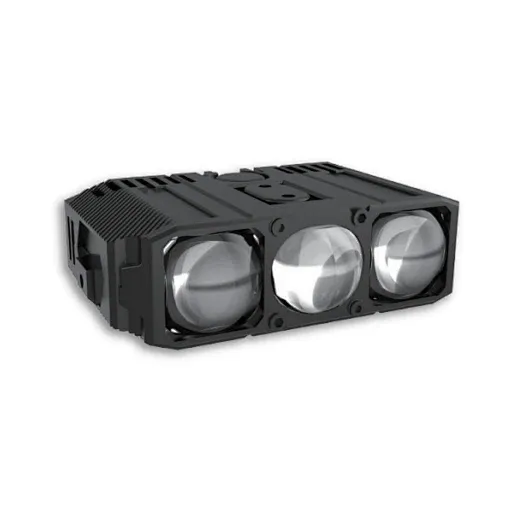
EKLIGHT EK-M5 is a three-lens auxiliary LED driving light series specified at 85W with selectable white and yellow lighting modes. It serves selected motorcycle, car and truck aftermarket applications, subject to the relevant mounting and electrical requirements. Wholesale buyers should compare beam coverage, operating modes, installation hardware and the stated model output. EKLIGHT supports product information, sample evaluation and OEM/ODM supply planning for suitable driving-light configurations.
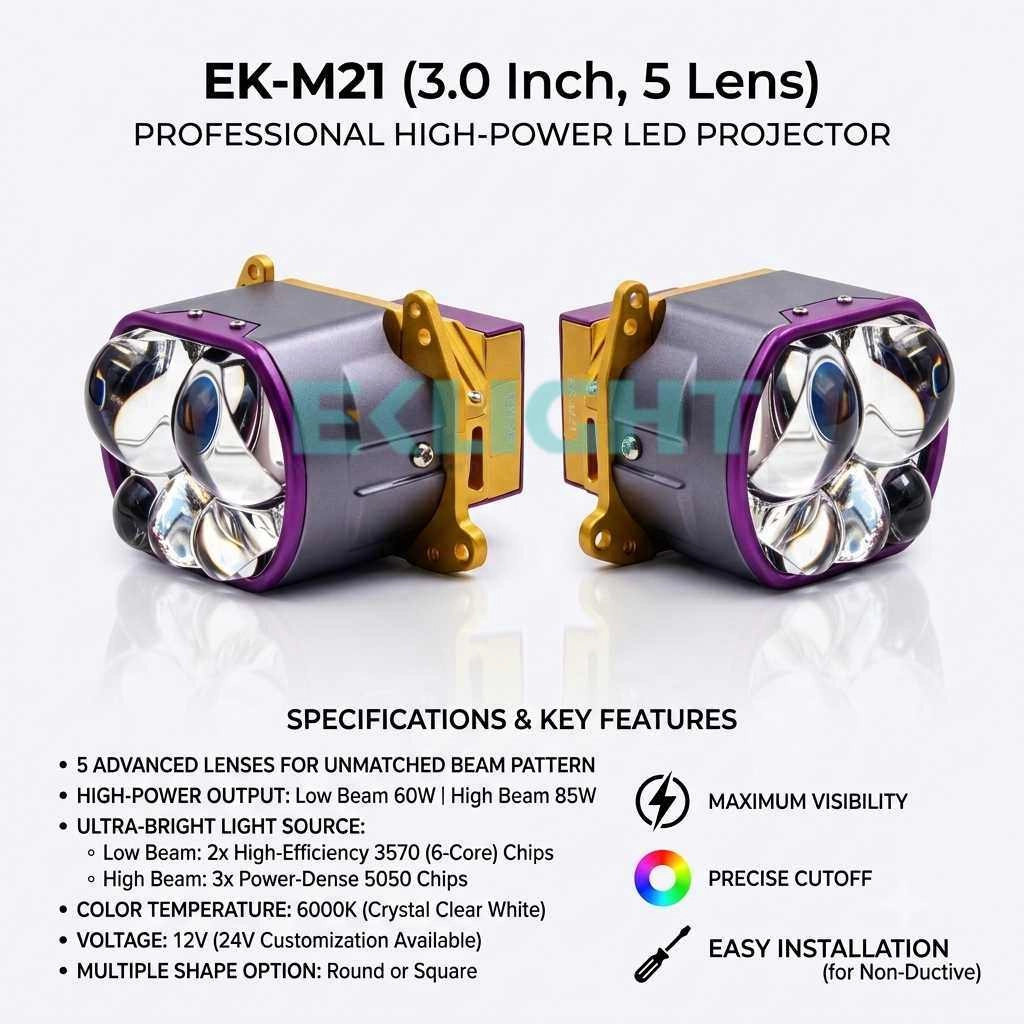
EKLIGHT EK21 is a 3.0-inch Bi-LED projector headlight model with a five-lens optical configuration, 3570 and 5050 LED chip design, and stated 60W low-beam / 85W high-beam ratings. This model is intended for compatible aftermarket headlight retrofit applications. Distributors and retrofit specialists should check the mounting geometry, installation depth, low/high beam operation and cutoff requirements before ordering. Contact EKLIGHT for product details, sample evaluation and wholesale supply.
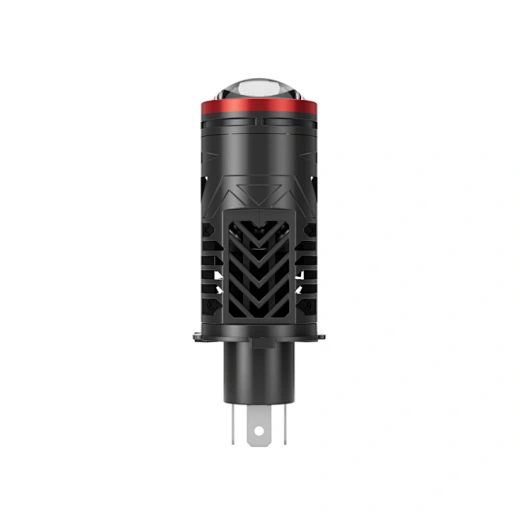
EKLIGHT H4 mini Bi-LED projector bulb combines compact integrated projector optics with high- and low-beam switching for selected H4 retrofit applications. The described model specifies 132W and 5200LM, with LHD/RHD configurations requiring confirmation during model selection. Before ordering, assess headlamp clearance, beam-cutoff direction, power requirements and installation hardware. EKLIGHT supports product samples, wholesale supply and applicable private-label packaging.
EKLIGHT delivers innovative, high-quality LED lighting solutions trusted by global partners.
We empower businesses with reliable products that enhance performance and drive success.
Contact EKLIGHT
Address : Building C, Dehuiwanggang Industrial Zone, No. 38 Wanggang Industrial three road, Baiyun district, Guanghzou, Guangdong province, China.
© 2026 EKLIGHT. All Rights Reserved.
EKLIGHT
EK
EK
EK
EK